

Short answer
Collin County's clay swells when wet and shrinks when dry, so water that pools against one side of a house, or roots that dry out one corner, can make a foundation move unevenly. Drainage correction means getting water away from the foundation and keeping moisture even: grading the soil to slope away, sending downspouts well clear of the house, adding underground drains where grading isn't enough, and managing trees. It is often part of a repair plan, and an independent engineer can tell you what your lot needs.
Why moisture control matters on expansive clay
By our analysis of the USDA's NRCS soil survey data, the most common soil in Collin County is Houston Black clay, rated as having very high shrink-swell potential and covering roughly 37% of the county. A Texas A&M AgriLife soil scientist put it simply in a 2022 interview: "When they get wet, they swell, and when they get dry, they shrink."
The Foundation Performance Association, a Houston group of engineers and industry members, says in its maintenance guide that "uniformity is the key: uniform moisture content in the soil, uniformly maintained in all areas around the foundation." If the soil changes evenly, the house tends to move evenly. If one side is soaked by a downspout and another is dried out by a tree, the foundation can move differentially, and that is what cracks walls and sticks doors.
This is why engineers often recommend drainage work alongside, or instead of, structural repair. Piers can support a foundation, but they don't stop the soil around them from swelling and shrinking.
Grading: the ground should fall away from the house
The model International Residential Code, section R401.3, says lots "shall be graded to drain surface water away from foundation walls," and that the grade "shall fall not fewer than 6 inches ... within the first 10 feet" (IRC 2021, R401.3). Where lot lines or walls make that impossible, the code allows a 5% slope with drains or swales. Cities adopt the code with their own amendments, so ask your building department which version applies.
The Foundation Performance Association's guide suggests a simple check: after heavy rain, see whether water pools near the foundation, and whether the grade falls at least an inch per foot for the first 5 feet around the house. If it doesn't, its suggested fixes are to regrade with sandy clay fill (not sand alone) or to add underground drainage.
Common grading problems around Collin County homes:
- Flowerbeds built up higher than the lawn, with edging that traps water against the slab. The FPA guide advises against "metal edging or other damming devices within five feet of the foundation."
- Patios, walkways or driveways that tilt toward the house
- Soil or mulch piled up against siding or covering weep holes in brick
- Low spots between houses where neighboring yards drain together
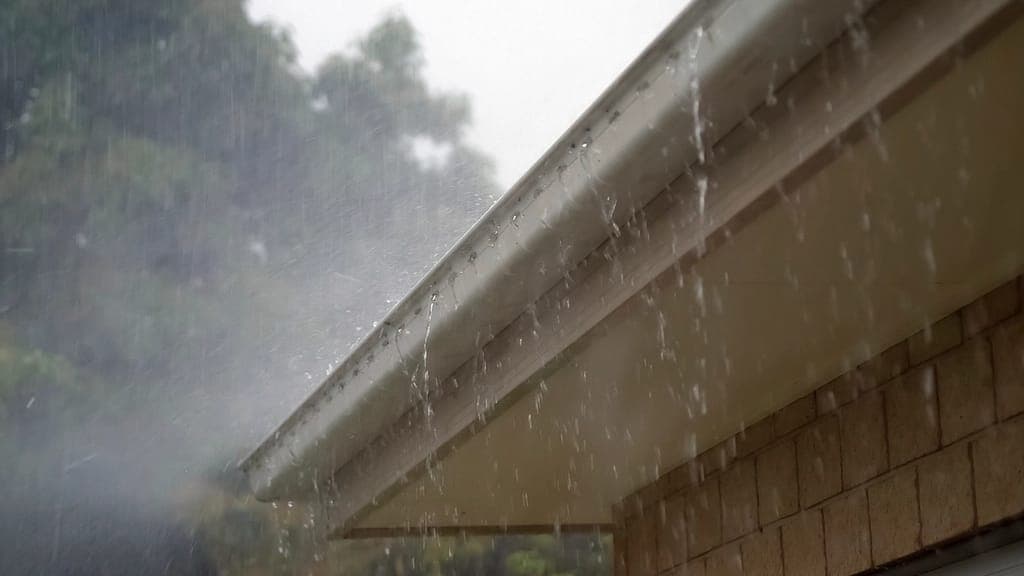
Gutters and downspouts
A roof collects a lot of water and drops it in a few places. If those places are at the edge of the slab, that soil stays wetter than the rest. The FPA's owner's guide recommends downspout extensions that discharge "at least 5 feet from the Foundation edge," or connecting downspouts to underground drainage pipe. Its maintenance guide suggests 5 to 10 feet.
The owner's guide also flags a detail that is easy to miss: using slotted (perforated) drain pipe as a downspout extension, which leaks water along its length instead of carrying it away. Solid pipe does the job.
French drains, area drains and swales
When grading alone can't move water away, the usual next steps are:
- Swales: shallow, sloped channels in the yard, grass or gravel lined, that carry surface water around the house.
- Area drains: grated inlets in low spots, connected to underground pipe that carries water to the street or another outlet.
- French drains: the FPA defines these as underground systems "designed to collect and convey subsurface water," typically a gravel-filled trench with perforated pipe.
Each needs a place to send the water and enough fall to get it there. The FPA's owner's guide lists "gravel or bull rock beds adjacent to or near the Foundation" among things that hold water near a house, so a drain that collects water but has nowhere to send it can make matters worse. If an HOA or the city has rules about discharging water to the street or a neighbor's lot, check them before work starts.
Trees and root barriers
Trees pull large amounts of water from clay soil. The FPA's maintenance guide says trees near the foundation "cause the majority of foundation problems requiring repair" in its area (the Houston region, which also has expansive clay), and notes that removing a large tree can also cause trouble, because the soil can swell back as it regains moisture.
Its owner's guide suggests planting large canopy trees such as oak, ash and pecan at least 12 feet from the foundation and small trees at least 8 feet away. Where trees are already closer, owners sometimes install a root barrier: a solid sheet of plastic, metal or concrete, or a chemically treated fabric, set vertically in the ground between the tree and the house. The FPA says barriers typically go 24 to 36 inches deep and that solid ones "will also limit water movement across the barrier," which is worth thinking through with an engineer or arborist first.
Watering the foundation in dry weather
In a drought, the soil next to a slab can dry and pull away, leaving a gap. Some owners water the soil near the foundation to keep it more even.
Plano's Water Management Plan defines the foundation zone for watering as "the first 24 inches of soil from foundation slab," and the city allows foundations to be watered "for up to 2 hours any day by a hand-held hose or soaker hose" (Plano 2026 watering release). The FPA advises not to water directly into a gap. Rules differ by city and change with drought stages, so read the foundation watering guide and check your city's current restrictions.
Who does this work, and what it costs
Drainage correction is done by foundation repair companies, landscapers, drainage and irrigation contractors, and gutter installers. If the work is part of a foundation repair, it should follow the engineer's recommendations, and it's worth asking the engineer to review the drainage plan too. Ask whoever quotes the work whether any part of it, such as changes to an irrigation system, needs a permit in your city.
Prices depend heavily on the lot: how far water has to travel, whether it can outlet to the street, and how much hardscape is in the way. This page doesn't quote a typical price because no reliable local figure was found. Get written bids that show the route, pipe type and outlet.
If an engineer has recommended drainage work alongside a repair, this guide can pass your request to a local foundation repair company. See how it works.
Frequently asked questions
How far should downspouts discharge from the foundation?
The Foundation Performance Association's owner's guide recommends at least 5 feet from the foundation edge on expansive soil, and its maintenance guide suggests 5 to 10 feet, using solid pipe or a connection to underground drainage.
How much should the ground slope away from my house?
The model residential code, IRC R401.3, calls for at least 6 inches of fall in the first 10 feet, with a 5% slope and drains or swales where lot lines or walls prevent that. Your city's adopted version may differ.
Can drainage work fix foundation movement on its own?
Sometimes it's part of the answer and sometimes it isn't enough. Whether a particular house needs drainage work, structural repair or both is an engineering judgment, so ask an independent Texas-licensed professional engineer.
Should I cut down a tree near my foundation?
Not without advice. The Foundation Performance Association notes that removing a large tree can cause the clay to swell back as it regains moisture. An engineer, and an arborist for the tree, can help you weigh pruning, a root barrier or removal.
Is a French drain the same as a gutter drain?
Not quite. A French drain collects water from the soil through a gravel trench and perforated pipe. A downspout drain carries roof water in solid pipe to an outlet. Many lots use both, and each needs a working outlet.