

Short answer
A crack is a symptom. Epoxy injection, polyurethane injection, repointing mortar and patching drywall repair the crack, not the movement that caused it, and concrete and masonry guidance says to find and correct the cause first. On Collin County's expansive clay the usual order is: have an independent engineer judge whether the foundation is moving, deal with drainage or plumbing, stabilize or lift if the engineer recommends it, then do the cosmetic work. HomeAdvisor's June 2026 national guide puts simple crack repairs at $250 to $800.
A crack is a symptom, not the repair
Most calls about foundations start with a crack: a line across the garage slab, a stair-step through the brick, a diagonal from the corner of a bedroom door. It's natural to want it fixed. The professional guidance for every material involved says the same thing, though. Fix the cause first.
- For concrete, the American Concrete Institute's field guide to structural crack repair by epoxy injection (RAP-1) says that "before any concrete repair is carried out, the cause of the damage must be assessed and corrected," and that "if the crack is subject to subsequent movement, an epoxy repair may not be applicable."
- For brick and mortar, the National Park Service's Preservation Brief 2 on repointing says it is "erroneous to assume that repointing alone will solve deficiencies that result from other problems," and lists "differential settlement of the building" among the root causes that "should always be dealt with prior to beginning work."
- For the house as a whole, the Texas Section of the American Society of Civil Engineers says in its residential foundation guidelines that "the majority of cracks do not compromise structural integrity." Some cracks need nothing more than cosmetic repair. Others are the visible end of ongoing movement.
Telling those apart for a particular house is an engineering judgment. The Texas engineering board said in advisory opinion 43 that "analyzing the cause of a condition, recommendations for repair, or providing any other expert engineering opinion associated with a foundation" is the practice of engineering. So this page explains how the common repairs work, in general terms, and leaves the question of what your house needs to an independent Texas-licensed professional engineer.
Why cracks are so common here
Collin County sits on Blackland Prairie clay. Its most common soil, Houston Black, is rated "very high" for shrink-swell in the USDA's NRCS soil survey data, and by our analysis of that data it covers about 40% of McKinney and more than half of Plano and Allen. The clay shrinks in dry summers and swells when rain returns, and houses move a little with it. Brittle finishes show that movement first. The Foundation Performance Association (FPA), a Houston group of engineers and industry members, notes in its maintenance guide that brittle surfaces "such as stucco, masonry, gypsum board (drywall), glass, and tile, cannot tolerate as much movement" as carpet, wood and vinyl.
That's why cracks can open in a dry August and partly close after fall rain. The drought and foundation movement guide explains the seasonal cycle, and signs of foundation problems covers which crack patterns engineering groups treat as more meaningful.
Slab and grade beam cracks
Concrete slabs commonly crack as they cure and shrink, and many of those cracks are harmless. The FPA's homebuyers' guide says hairline cracks in grade beams, the concrete under the exterior walls, "are generally acceptable but may indicate that there has been some foundation movement." Inside the house, slab cracks are usually hidden under flooring and show up as cracked tile.
Epoxy injection
Epoxy injection pumps a two-part resin into a crack through small ports, after the surface of the crack is sealed. Its purpose is structural. The ASCE Texas guidelines say injecting slab cracks "of about 1/32 inch and larger with epoxy repair cement is intended to restore stiffness across the injected crack," and ACI's RAP-1 says it "can restore structural integrity and reduce moisture penetration" in cracks as fine as 0.002 inch.
The catch is movement. Epoxy is meant to make the cracked concrete act as one piece again, which doesn't suit a crack that is still opening and closing. That is why RAP-1 says conditions causing the crack "must be corrected prior to proceeding with the epoxy injection."
Polyurethane and sealants
Polyurethane injection uses a polyurethane grout or foam instead of a rigid structural resin. It is used to fill and seal a crack against water rather than to restore strength. RAP-1 says that if a crack "does not compromise the structural integrity of the structure, injection with polyurethane grouts or other nonstructural materials may be a more suitable choice." The ASCE Texas guidelines make a similar point: if the goal is "solely to limit moisture intrusion or insect ingress," sealants may be appropriate.
In short:
- Epoxy: meant to restore stiffness, suited to cracks that are no longer moving
- Polyurethane or sealant: meant to fill and seal against water or insects, not a structural repair
- Neither: stops the soil under the slab from moving
Brick veneer and mortar cracks
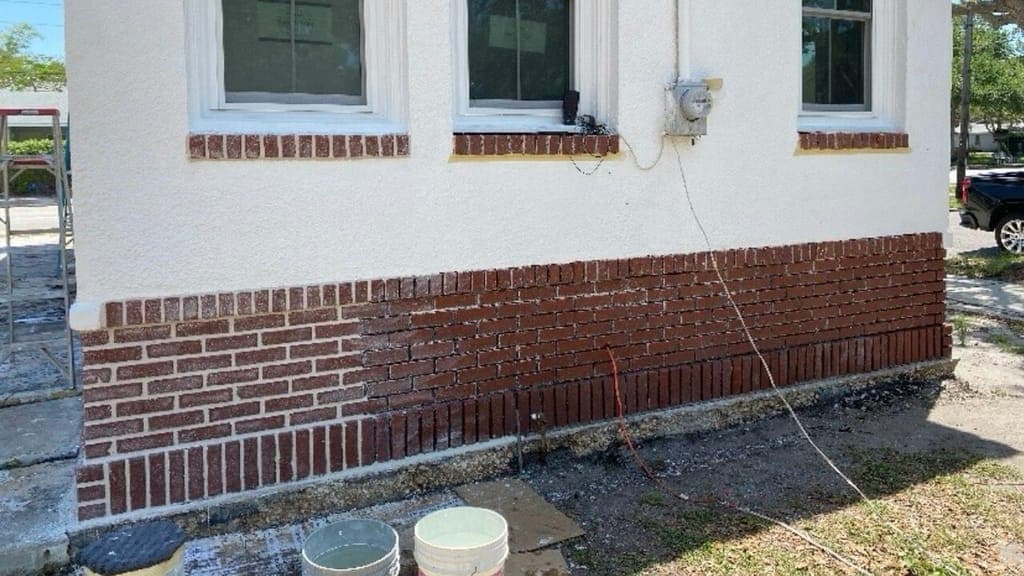
Brick on a typical house is veneer, not the structure holding up the house. The FPA homebuyers' guide defines brick veneer as a "non-structural wall covering," and the ASCE Texas guidelines say masonry veneer "is normally non load-bearing." It still shows movement clearly, which is why stair-step cracks through mortar joints are one of the most recognized signs of foundation movement.
Repointing (often called tuckpointing)
The standard repair for cracked or failing mortar is repointing: grinding or raking out damaged mortar to a set depth and packing in new mortar. Contractors often call it tuckpointing. The National Park Service notes that the term is "somewhat inaccurately" used, since tuckpointing "technically describes a primarily decorative application" of a raised joint. Either way, ask exactly what the work includes.
Two points from Preservation Brief 2 apply to any brick house, historic or not:
- Fix the cause first. Repointing over active movement tends to crack again. The brief says that without repairs to eliminate the source of the problem, "mortar deterioration will continue and any repointing will have been a waste of time and money."
- Softer is right. New mortar "should be softer or more permeable than the masonry units." The brief calls it "a common error to assume that hardness or high strength is a measure of appropriateness," because a wall has to accommodate expansion, contraction and settlement somewhere, and it's better for that to happen in the mortar than in the brick.
Individual bricks that have cracked through may need to be cut out and replaced, and brick expansion joints that have closed or widened may need to be redone with sealant. This is masonry work, so ask whether the foundation repair company does it or whether you'll need a mason.
Why patched mortar raises questions
Patched mortar is visible. The FPA homebuyers' guide tells buyers to look for mortar repair, which often shows as a different shade, and to "ask why they were done," because "mortar repair can be a sign of foundation movement." That's not a reason to avoid repairs. It is a reason to keep the paperwork: if an engineer said the movement was minor and cosmetic repair was appropriate, or the house was stabilized first, that record answers the question when you sell. Texas sellers must give buyers a Seller's Disclosure Notice that asks about previous structural repairs; see warranties and resale.
Interior drywall cracks
Drywall cracks are the most common complaint and the most often harmless. The FPA homebuyers' guide distinguishes them:
- Diagonal cracks from the corners of windows and doors are "significant indicators of excessive foundation movement."
- Buckled tape, separations at corners or tape joints, and small hairline cracks "are most often related to initial 'settling,'" drywall installation and wood shrinkage, and "are not commonly a sign of foundation problems."
Repair itself is ordinary drywall work: cut out or open the crack, re-tape, mud, sand, texture and paint. The question is timing. Patching a crack that is still opening means patching it again. Keeping a simple log helps: pencil a mark and date at each end of the crack and photograph it with a coin or ruler. A crack that stays the same through a full summer and winter tells an engineer something different from one that keeps growing.
The ASCE Texas guidelines recognize that repair isn't always the right call. They say an owner "may choose to perform periodic cosmetic repairs and door adjustments, rather than comprehensive foundation underpinning," and that engineers should weigh cost effectiveness and practicality. That is an option to discuss with an engineer who has looked at the house, not a conclusion to reach from a photo.
The usual order of work
When an engineer recommends structural repair, the sequence generally runs like this:
- Evaluation. An independent engineer looks at the pattern of cracks, measures floor elevations and judges whether and where the foundation is moving. See engineer evaluation.
- Moisture sources. Leaks, gutters, grading and trees are addressed, because they can keep driving movement. See drainage correction and plumbing leaks and foundation movement.
- Stabilizing or lifting, if the engineer's design calls for it, under a city permit. See slab foundation repair.
- Plumbing tests after lifting. The ASCE Texas guidelines say supply and drain lines should be tested for leaks whenever lifting is part of the repair.
- Structural crack repair and tendon work, if specified. The ASCE guidelines say restressing post-tensioned tendons "should be performed after elevation adjustments and epoxy crack injecting, if any."
- Cosmetic repairs: repointing, brick replacement, drywall, paint, trim and door adjustments.
Lifting itself changes the cracks. The FPA's pressed pile installation guideline tells installers to "attempt to close any masonry and/or drywall cracks as much as possible" during lifting and to check that doors and windows work afterward. Some cracks close, some open, and that is why cosmetic work waits.
What crack repair costs
National cost guides give a rough sense of scale. They are not quotes, and they aren't specific to Collin County:
- Foundation crack repair: $250 to $800, according to HomeAdvisor's foundation repair cost guide (updated June 20, 2026), which says this fix involves "injecting either epoxy or polyurethane foam." The same guide says cracks wider than 1/8 inch warrant a professional evaluation.
- Brick repointing: about $1,450 on average, with $400 to $2,500 typical for a 100 square foot section; $3 to $15 per square foot for repointing and $5 to $25 for tuckpointing, per HomeAdvisor's repointing guide (updated June 17, 2026).
No sourced figure for drywall crack repair in Collin County was found. If cracks are a sign of foundation movement, the structural repair will usually cost far more than the cosmetic work; the cost guide has sourced ranges.
Questions to ask before anyone patches a crack
- Has an independent engineer said whether the movement behind this crack is ongoing?
- Is the crack being repaired for strength (epoxy) or to seal it (polyurethane or sealant), and why that choice?
- If it's a slab, is it post-tensioned, and how will the work avoid the tendons?
- For brick, what mortar will be used, how will it be matched, and will cracked bricks be replaced?
- Is the work warranted, and does the warranty exclude cracks that reopen from foundation movement?
- Does this work need a city permit? Foundation repair permits in McKinney, Plano, Frisco, Allen and Prosper cover structural work such as leveling and piers; ask the city about anything else.
If an engineer has recommended repair, this guide can pass your request to an independent local foundation repair company. See how it works, including how referrals are paid for.
Frequently asked questions
Does sealing a foundation crack fix the foundation?
No. Injection, patching and repointing repair the crack, not the soil movement that caused it. The American Concrete Institute says the cause of concrete damage must be assessed and corrected before repair, and that epoxy may not be suitable if a crack is still moving. Have an independent engineer judge whether movement is ongoing first.
What's the difference between epoxy and polyurethane crack injection?
Epoxy is a rigid resin meant to restore stiffness across a crack, suited to cracks that are no longer moving. Polyurethane is a nonstructural grout used mainly to fill and seal against water, and the American Concrete Institute suggests it or similar nonstructural materials where the crack doesn't compromise the structure.
Can stair-step brick cracks just be tuckpointed?
They can be repointed, but the National Park Service's repointing guidance says it's a mistake to assume repointing alone will fix problems such as differential settlement. If the foundation is still moving, the new mortar is likely to crack again. Get the cause checked first.
How much does foundation crack repair cost?
HomeAdvisor's national guide, updated June 20, 2026, puts foundation crack repairs at $250 to $800, and its repointing guide puts brick repointing at about $1,450 on average. These are national figures, not quotes. Structural foundation repair, if needed, costs considerably more.
Should I repair cracks before or after foundation leveling?
After. Lifting moves the house, so cracks can close, open or appear during the work. Engineering guidelines put tendon restressing after lifting and epoxy injection, and cosmetic repairs such as drywall, mortar and paint generally come last. Ask whether they are included in the foundation bid, since warranties usually exclude finishes.