

Short answer
On North Texas clay some seasonal movement is normal, and most small cracks are cosmetic. The signs that engineering groups treat as more meaningful are diagonal drywall cracks from door and window corners, stair-step or widening brick cracks, doors that rack out of square, noticeably sloping floors, and cracks that keep growing. None of them diagnoses a house on its own. If you see several together, or they get worse, have an independent Texas-licensed professional engineer look before you talk to anyone selling repairs.
Why houses here move at all
Most of Collin County sits on Blackland Prairie clay. The most common soil in the county, Houston Black, has a plasticity index of roughly 44 to 55 and a "very high" shrink-swell rating in the USDA's NRCS soil survey data, and it covers more than half the land in Plano and Allen by our analysis of that data. A Texas A&M AgriLife soil scientist put it simply in a 2022 interview: "When they get wet, they swell, and when they get dry, they shrink."
A house on that soil moves with it. The Foundation Performance Association, a Houston group of engineers and industry members, says in its maintenance guide that this movement "does not mean the foundation is improperly designed or that it has failed." What causes visible damage is uneven movement: one side of the house drying out or wetting up faster than another.
The signs, and what engineering groups say about them
The Texas Section of the American Society of Civil Engineers lists the visible signs of foundation performance problems in its Guidelines for the Evaluation and Repair of Residential Foundations (version 2; a third version was adopted in 2022). Their list includes cracked or separating exterior walls, cracked drywall, walls separating from ceilings or floors, and "racking of door and window frames." The same document also says "the majority of cracks do not compromise structural integrity." Both things are true, which is why the pattern matters more than any single crack.
Doors and windows that stick
A door that rubs at the top corner, won't latch, or shows a wedge-shaped gap above it can mean the frame has been pushed out of square. It can also be humidity, a loose hinge or a sagging header. The FPA's maintenance guide suggests checking that each door "does not stick, swing open, or shut on its own." One sticking door is common. Several on the same side of the house is a pattern.
Drywall cracks
The FPA's homebuyers' guide is specific here. It calls diagonal cracks from the corners of windows and doors "significant indicators of excessive foundation movement," while buckled tape, separations at corners or tape joints, and small hairline cracks "are most often related to initial settling," drywall installation and wood shrinkage, and "are not commonly a sign of foundation problems."
Brick cracks and stair-step mortar cracks
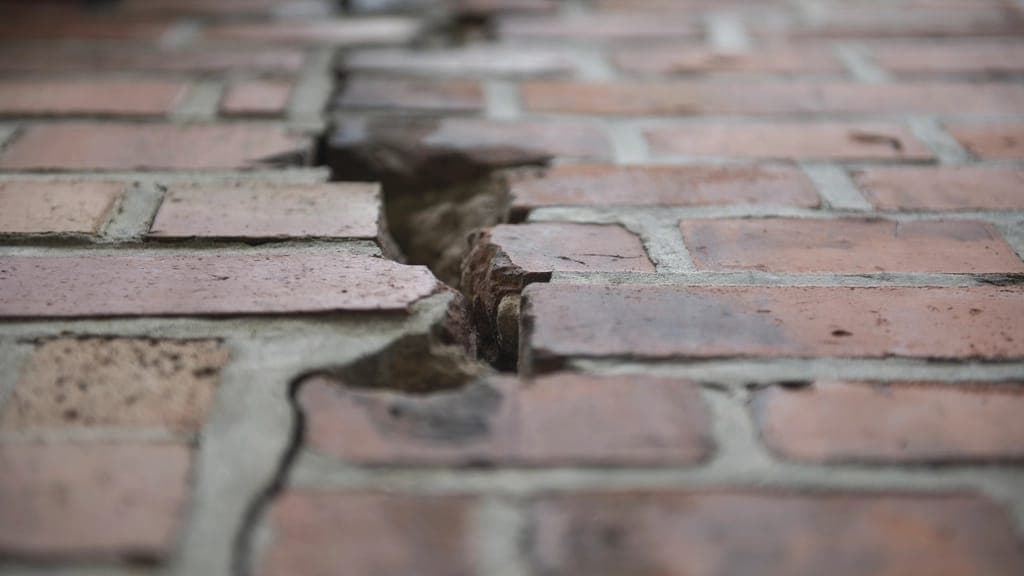
Brick veneer is a wall covering, not the structure holding up the house, but it shows movement well. The FPA guide suggests recording whether a crack runs through more than one brick, whether it's wider at the top or the bottom, and whether it sits near a window or door. It also flags brick expansion joints that are wider at one end than the other, and mortar that has been patched, as possible signs of past movement. A crack that steps up through the mortar joints like a staircase is the classic pattern people notice. Measure it and photograph it with a coin for scale so you can tell later if it's growing.
Sloping floors
The FPA homebuyers' guide suggests laying a 4-foot carpenter's level on the floor. It says a slope of "more than about one-quarter inch over four feet" may be a sign of unacceptable foundation movement, and that "a licensed professional engineer should be consulted." Marbles and phone apps are less reliable than a level, and new floors can hide or exaggerate slope.
Gaps at trim, cabinets and garage doors
Separations in exterior trim can mean foundation movement, "poor workmanship, or wood shrinkage," the FPA guide says. It also mentions separations around garage doors, especially wide double doors, which can come from movement or from an undersized header. Inside, look for cabinets pulling away from walls and baseboards opening up from the floor.
Slab edge and corner cracks
Look at the exposed concrete at the bottom of the outside walls. The FPA guide says "hairline cracks in the grade beams are generally acceptable but may indicate that there has been some foundation movement." A small crack or chip at a slab corner is something many homeowners find; whether any particular crack matters is a question for an engineer, not for a salesperson or a website.
Seasonal movement: why summer looks worse
NOAA's 1991 to 2020 normals for McKinney's airport show July and August as the driest months, averaging under 2 inches of rain each with normal highs around 95 F, while May and October are the wettest. Clay dries and shrinks through late summer, then swells again with the fall and spring rains. Many homeowners see doors stick and cracks open in August, then close up again after the rain returns.
2026 is a sharp example. The US Drought Monitor showed no drought in Collin County on August 11, 2026, and 79% of the county in extreme drought or worse by September 22. A quick swing back to heavy rain after a dry spell is the kind of change that shows up in walls and doors.
Seasonal opening and closing isn't automatically a problem, but it is useful information. Note which cracks move with the seasons and which only grow.
New homes and older homes
The FPA's maintenance guide says soils around a new foundation "normally stabilize within the first one or two years," and that this early movement "should not cause more than hairline cracking." If you see more than that in a new house, its advice is to contact the builder or engineer of record. Much of Collin County's housing is new: Census estimates put the median year built at 2014 in Prosper and 2009 in Frisco, against 1993 in Plano (ACS 2020 to 2024, table B25035). An older house may also carry a past repair, so ask for any paperwork.
What to do next
- Record what you see: photos, crack widths, dates, and which doors stick.
- Check the simple things: gutters and downspouts, soil sloping toward the house, sprinklers spraying the wall, a leaking outdoor tap.
- Rule out a plumbing leak if your water bill has jumped. See slab leaks and foundation movement.
- Get an independent opinion. Only a licensed engineer can say what is causing the signs in your house. The Texas engineering board said in advisory opinion 43 that "analyzing the cause of a condition, recommendations for repair, or providing any other expert engineering opinion associated with a foundation" is the practice of engineering. The engineer report vs free inspection guide explains why that opinion is worth paying for before anyone quotes a repair.
If an engineer recommends repair, this guide can pass your request to a local foundation repair company for a bid. See how it works, including how referrals are paid for.
Frequently asked questions
Are cracks in my walls a sign of foundation problems?
Not always. The ASCE Texas Section's guidelines say the majority of cracks do not compromise structural integrity, and the Foundation Performance Association says small hairline drywall cracks are usually from settling, installation or wood shrinkage. Diagonal cracks from door and window corners, and cracks that keep growing, are the ones worth an engineer's look.
Is it normal for doors to stick in summer in North Texas?
Some seasonal movement is common on expansive clay, which shrinks in the dry months and swells when rain returns. A single sticking door may just be humidity or hinges. Several doors on one side of the house, or frames visibly out of square, are a pattern to show an engineer.
What do stair-step cracks in brick mean?
They show the brick veneer has moved, often from foundation movement, but brick is a wall covering, not the structure. Measure and photograph the crack, note whether it's wider at the top or bottom, and watch for growth. An independent engineer can say whether it matters for your house.
How much floor slope is too much?
The Foundation Performance Association's homebuyers' guide suggests using a 4-foot level and says more than about a quarter inch over four feet may be a sign of unacceptable movement that a licensed professional engineer should look at.
Can a foundation repair company tell me what's wrong with my foundation?
It can tell you what it proposes to sell. The Texas engineering board's advisory opinion 43 says analyzing the cause of a foundation condition and recommending repairs is engineering practice, and every Collin County city checked requires a Texas-licensed engineer's sealed design for a permit. An independent engineer's report first gives you something to compare bids against.